
This post contains affiliate links. I earn a commission on purchases made through these links at no additional cost to you.

Your guest list is not a list of people you want to celebrate with. It is your wedding budget. Every name on that list represents a seat, a meal, a drink, a piece of stationery, a party favor, and a fraction of the venue cost. The single most powerful thing you can do to control what your wedding costs is to control how many people are on that list, before you book anything else.
This guide covers everything I tell couples at that first meeting: how to build a guest list that serves your budget, how to make the cuts that need to be made, how to handle family expectations, and how to arrive at a final number that gives you the wedding you actually want rather than the wedding you accidentally drifted into.
Why Your Guest List Controls Everything, Not Just Catering
Most couples understand that a larger guest list means a higher catering bill. What they do not always understand is that every additional guest adds cost in multiple budget categories simultaneously. This is why cutting the guest list is the most efficient budget lever in all of wedding planning.
Here is what each additional guest actually costs you:
A seat at the venue, whether that is a chair rental, a place at a rented table, or a dedicated floor plan space that pushes you into a larger venue tier.
A catered meal, typically between $75 and $150 per person for a plated dinner, or $55 to $100 per person for a buffet.
A drink — an open bar is typically priced per person for a set number of hours, meaning every additional guest increases your bar tab proportionally.
An invitation — paper, printing, envelope, postage, and any additional inserts like RSVP cards or accommodation information.
A favor — if you are offering one.
A piece of wedding cake — most bakers price by the slice.
Transportation — for larger guest counts, shuttle or transportation costs scale upward.
A response to manage — RSVPs, dietary restrictions, seating chart placement, and follow-up for non-responders all require time and coordination.
This post will help with wedding guest list rules no one tells you about.
The commonly cited average cost per wedding guest in the United States in 2026 runs between $250 and $350 per person when all categories are factored in. On a guest list of 150 people, that is between $37,500 and $52,500 in guest-driven costs. Cut the list to 100, and you save between $12,500 and $17,500 before negotiating a single vendor contract.

For a complete breakdown of how catering and other guest-driven costs fit into the full wedding budget, the Wedding Budget Breakdown guide covers every category with exact percentages and a free budget worksheet.
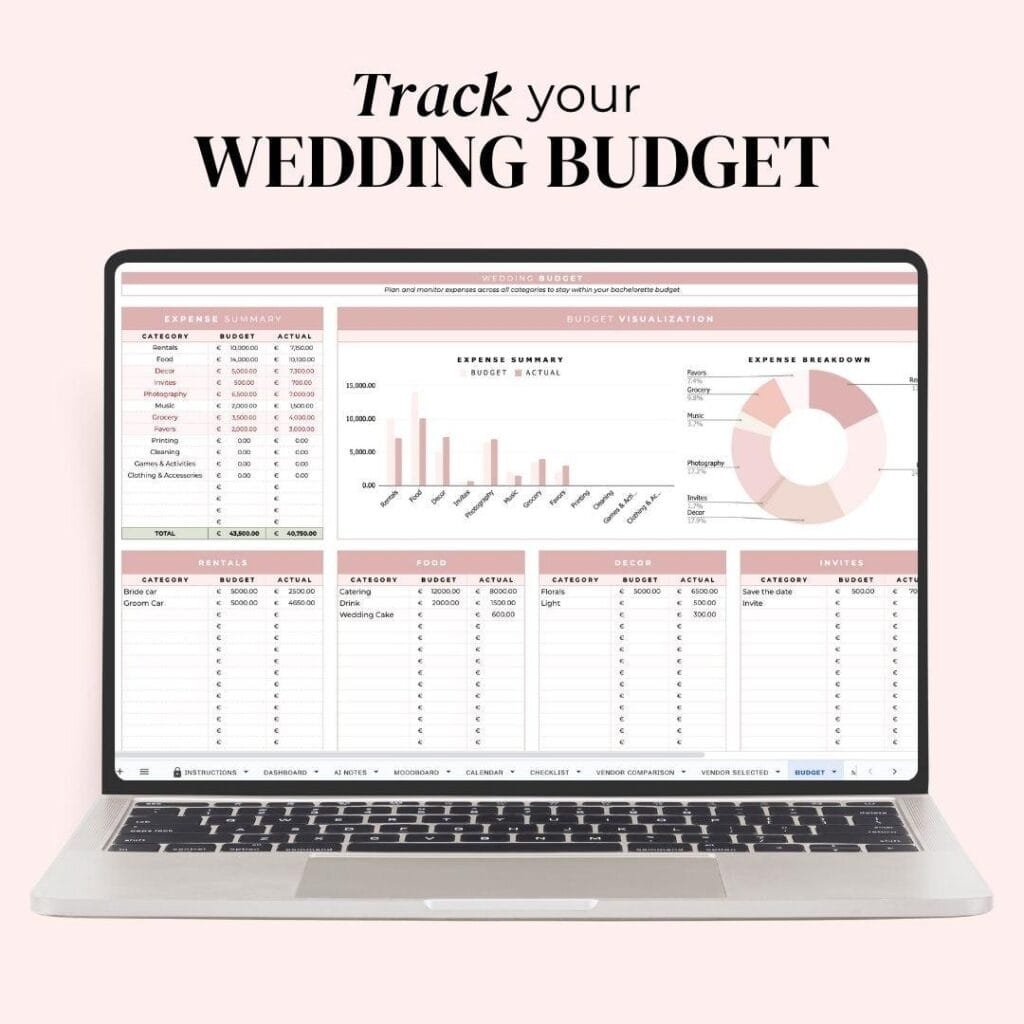
I have created a done-for-you wedding budget spreadsheet that is completely editable and ready for you to track all of your expenses.
Start Your Guest List Before You Start Anything Else
The most common guest list mistake I see is couples who build their list after they have already fallen in love with a venue. They tour a property that holds 200 guests comfortably and without quite deciding to, they begin imagining 200 people in the space. By the time the venue is booked, the mental guest list has already expanded to fill it.
The correct order is the opposite. Set your ideal guest count before you research a single venue. That number, not the venue’s capacity, should drive every venue decision that follows.
The way I recommend building the initial list is in three separate steps.
Both partners write their lists independently without discussing them first. This prevents each partner’s list from being unconsciously shaped by what the other person seems to want. It also surfaces honest differences in priority that need to be resolved before any invitations are sent.
The two lists are combined, and duplicates are removed. The result is a raw list, usually longer than either partner expected.
The raw list is then organized into the three tiers described in the next section.
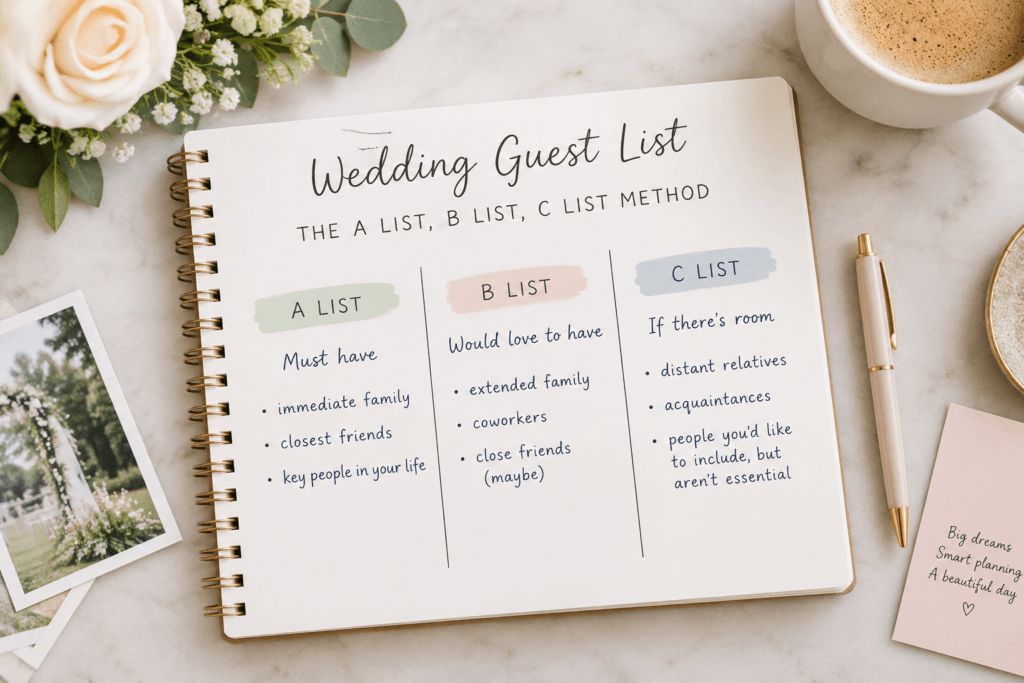
The A/B/C Guest List Method
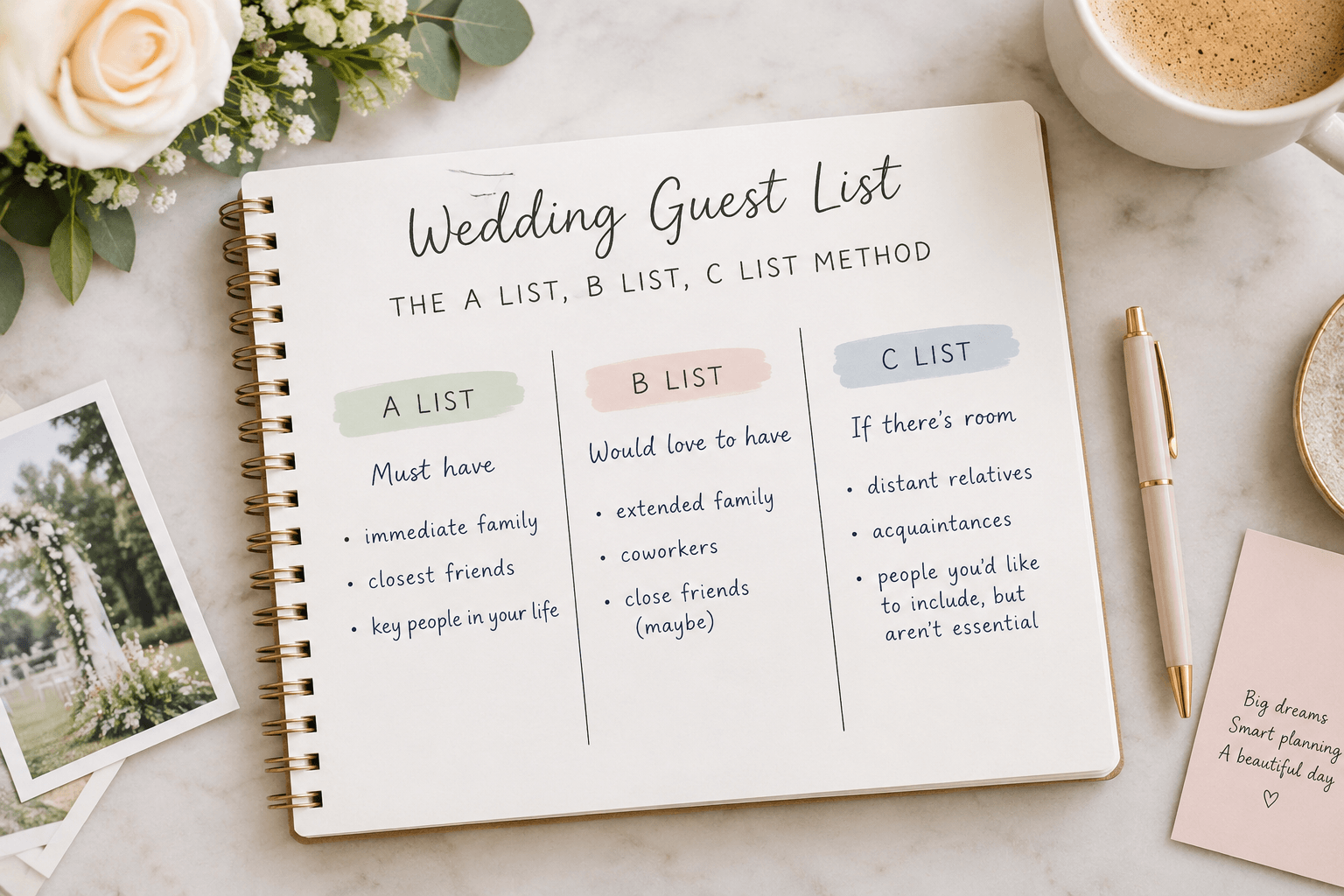
The three-tier guest list method is one of the most practically useful planning tools available, and it is genuinely underused. Here is how it works.
The A List
The A list is your non-negotiable guest list, the people who will be invited to your wedding under any circumstances, regardless of the venue size or budget. This group should be small enough to fit in the smallest venue you would realistically consider. For most couples, the A list runs between 30 and 60 people.
A list criteria: immediate family on both sides, your closest friends, the ones you speak to regularly and who have been present in your life in a meaningful way, and anyone whose absence would genuinely alter the character of the day.
The B List
The B list contains people you genuinely want at the wedding but who will only be invited if the budget and venue allow. Extended family members you see occasionally, work colleagues you genuinely like, childhood friends you have drifted from but still care about.
B list invitations are sent after A list RSVPs come in and you know how much room you have. This is a completely acceptable and widely practiced approach. The key is timing: B list invitations need to go out early enough that recipients do not realize they were on a secondary list.
The C List
The C list is the obligation list: people who feel like they should be invited because of a family relationship, a professional connection, or social pressure, but whose presence will not meaningfully contribute to your wedding day. Neighbors your parents feel obligated to include. Distant cousins you have met three times. Business associates of your parents.
The C list is the first to be cut when the budget requires it. Most couples feel guilty cutting these guests and then arrive at the wedding feeling relieved they did.
The Real Number: How Many Guests Should You Invite?
There is no universal answer to how many guests belong at a wedding, but there is a useful framework: your guest count should be determined by your per-person budget, not by anyone’s expectations.
Here is the math. Take your total wedding budget and multiply it by 0.50 — this is the approximate share that guest-driven costs (catering, bar, rentals, stationery) will consume. Divide that number by $300, which is a reasonable average cost per guest in 2026. The result is your realistic maximum guest count.
On a $25,000 budget: 25,000 x 0.50 = $12,500 ÷ $300 = approximately 42 guests.
On a $40,000 budget: 40,000 x 0.50 = $20,000 ÷ $300 = approximately 67 guests.
On a $60,000 budget: 60,000 x 0.50 = $30,000 ÷ $300 = approximately 100 guests.
This is not a rigid formula — costs vary significantly by market and vendor choices. But it gives couples a realistic starting point before the guest list conversation becomes wishful thinking.
Who Gets Cut First: The Decisions Most Couples Avoid
Once the A/B/C framework is in place, most couples find that the cuts sort themselves into predictable categories. Here are the ones I recommend addressing first.
Work Colleagues
Unless you genuinely socialize with a work colleague outside of the office, they belong on the C list. Inviting colleagues because it would be awkward not to is one of the most common sources of guest list inflation, and it rarely produces a meaningful addition to the wedding day. If you invite one colleague, social pressure to invite others in the same department or at the same level follows quickly.
The exception: a colleague who has become a genuine close friend whose absence would feel like a real loss.
Plus-Ones for New or Casual Relationships
Automatically offering plus-ones to every guest on the list can add twenty to forty people to your count before you realize what has happened. The cost of each plus-one is identical to the cost of a primary guest.
The framework I recommend: plus-ones are offered to guests who are in committed long-term relationships or married, and to guests who will not know anyone else at the wedding and would otherwise be genuinely isolated. Beyond that, a politely worded invitation addressed only to the named guest is completely acceptable.
Children
An adults-only or adults-primarily wedding is one of the most effective ways to control both guest count and per-person costs. Children eat, they require seats, and they are counted in every per-person catering line. A wedding with twenty children in attendance is functionally twenty additional guests in the catering budget.
For detailed guidance on communicating an adults-only policy gracefully, the How to Politely Say No Kids on Your Invitations guide covers exact wording for every situation.
Distant Family Your Parents Insist On
This is the hardest category for most couples to navigate because it involves family relationships that extend well beyond the wedding itself. The most effective approach is to frame the decision in terms of venue capacity rather than personal preference — “the venue holds a maximum of X guests” is far easier for families to accept than “we decided not to invite your cousins.”
Set the limit early, communicate it to all family contributors simultaneously so no single branch of the family can claim an exception, and hold the line. For more guidance on navigating these conversations, the Wedding Planning FAQs guide covers the family dynamics questions I hear most often.
How to Handle Family Pressure on the Guest List
Family guest list pressure is one of the most consistently difficult parts of wedding planning, and it is especially acute when parents are contributing financially to the wedding. The expectation that financial contribution purchases guest list seats is real, common, and worth addressing directly before the planning begins.
My recommendation after 35 years of watching this play out: establish the guest list framework- total count, A/B/C tiers, and any category rules like a plus-one policy — before accepting any financial contributions from family members. Once a contribution is accepted, the implicit negotiation about seats becomes significantly harder to manage.
When families have contributed and are therefore expecting some input on the guest list, I suggest offering a fixed number of seats — say, ten per parental unit — that they can allocate however they choose within their allocation. This acknowledges their contribution with something concrete while containing the expansion.
The Micro Wedding Alternative: When Smaller Is Better
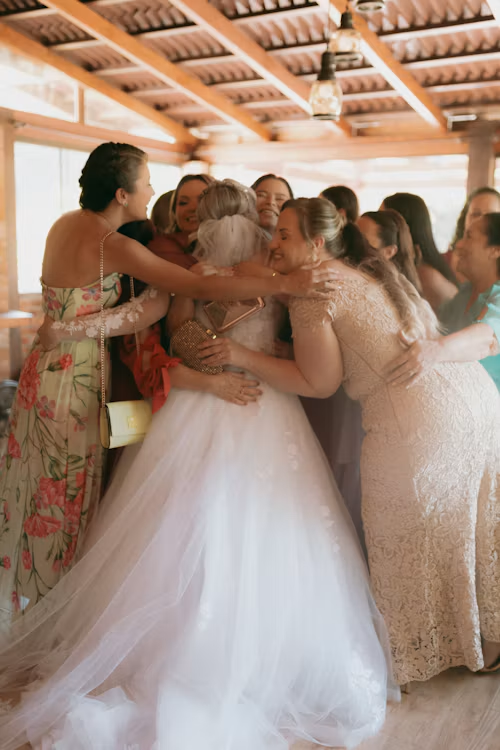
For couples whose A list is genuinely small, under 25 or 30 people, the micro wedding format deserves serious consideration rather than being treated as a budget constraint. A wedding of 20 guests done well is more intimate, more personal, more memorable for the guests who attend, and dramatically more affordable than a 150-person event.
The venues available at a micro wedding scale include options that would never accommodate larger guest counts: a private dining room at a beautiful restaurant, a boutique hotel suite, a family property, or a rented private space through Swimply that transforms a beautiful outdoor location into a completely personalized setting.
For a full exploration of micro wedding venue options, the Micro Wedding Venues guide covers twelve venue types at every budget level.
Managing Your Guest List Logistics
Once the final list is established, managing RSVPs, dietary restrictions, seating chart assignments, and communication across a large group requires a reliable system.
A wedding website is the most practical tool available for this. It provides a single location where guests can RSVP digitally, review event details, submit dietary restrictions, and find accommodation information, eliminating the paper RSVP card process entirely for guests who prefer digital response. WedSites offers a free platform that handles all of this beautifully alongside your registry link and event logistics.
For the invitation itself, the stationery is where the guest list first becomes visible to recipients — and a beautifully designed suite sets the tone for the entire experience. FineStationery offers an exceptional selection of customizable wedding invitation suites at accessible price points, including digital options that reduce both cost and turnaround time significantly.

For couples who want a more bespoke invitation experience, Etsy has a wide selection of independent designers offering personalized suites, custom wax seals, and handmade details that make the guest list’s first impression genuinely special.
Setting Up Your Registry Alongside Your Guest List
Once your guest list is finalized and your invitations are in order, your gift registry is the natural next step — and the guest list size directly informs how you structure it. Couples with smaller guest lists often prefer a cash honeymoon fund or experience-based registry rather than a traditional household registry, since a smaller group of close guests may prefer to contribute to something meaningful rather than purchase from a standard list.
MyRegistry.com allows you to combine traditional registry items from multiple stores with a honeymoon fund in one shareable list, which gives guests the flexibility to choose what feels right for their relationship with you. For more guidance on building your registry, the Wedding Gift Registry Guide covers every format and platform in detail.
Frequently Asked Questions About the Wedding Guest List
The right number is the one your budget can support, not a social expectation or a venue’s maximum capacity. On most wedding budgets, the realistic guest count that allows for a genuinely beautiful, well-executed celebration runs between 50 and 100 guests. Micro weddings of 25 or fewer allow for the most personalized and intimate experience. Guest counts above 150 typically require either a very large budget or significant compromises across every other planning category.
Start by separating your list into three tiers: non-negotiable guests, genuine wants, and social obligations. Cut from the obligation tier first. Then evaluate plus-ones for casual relationships, children if the event can reasonably be adults-only, and work colleagues with whom you do not maintain a genuine friendship outside the office. The test for every borderline guest is specific and honest: would their absence meaningfully diminish your wedding day? If the honest answer is no, they belong on a lower tier.
Establish a fixed allocation — a set number of seats that each parental unit can use for their own guests — and communicate this allocation before any other guest list conversations begin. Framing the allocation in terms of venue capacity rather than personal preference reduces friction significantly. Once the allocation is agreed upon, what they do with those seats is their choice, and you retain control of the rest of the list.
The commonly cited average runs between $250 and $350 per guest when you fully allocate catering, bar, rentals, stationery, favors, and venue costs across the head count. In major metropolitan markets, this figure is often higher. The most reliable way to calculate your own per-person cost is to divide your total catering and venue contract value by your guest count — that number tells you what each guest is actually costing in the two largest categories alone.
Save the dates typically go out six to eight months before the wedding for local guests and eight to twelve months for destination weddings or events over holiday weekends. Invitations typically go out six to eight weeks before the ceremony. If you are using an A/B list approach, A list invitations go out on the standard schedule and B list invitations follow as A list RSVPs arrive — typically within two to three weeks of the original send date to give B list recipients adequate notice.
Address invitations specifically to the named guests only, “Sarah Johnson” rather than “Sarah Johnson and Guest.” This is a long-standing etiquette convention, not a modern rudeness, and most guests understand it immediately. For guests who call or write to ask about bringing a guest, a warm and honest response works best: “We are working within a very specific guest count and are not able to accommodate additional plus-ones — we hope you understand and we cannot wait to celebrate with you.” Then hold the line.
Final Thoughts
The guest list conversation is the one most couples wish they had started differently. They wish they had set the number before they fell in love with a venue. They wish they had talked about it as a couple before bringing families into it. They wish they had been honest about the A/B/C tiers from the beginning rather than letting social pressure build lists that the budget could not support.
What I tell every couple at the start of this process is the same thing: this is not a list of people you are inviting to a party. This is a deliberate, intentional decision about who you want present for one of the most significant moments of your life. That framing- who belongs in the room when this happens- makes every difficult cut easier to make.
A smaller, more intentional guest list almost always produces a more meaningful celebration than a larger, obligation-driven one. The couples who are most present on their wedding day, who most fully enjoy every moment of the reception, and who look back most warmly on the experience are almost always the ones who made room for the right people rather than all the people.
For the complete framework for building your wedding budget around your guest list from the beginning, the Wedding Budget Breakdown guide walks through every category in the correct planning order. And for the month-by-month planning timeline that shows exactly when the guest list should be finalized in relation to every other vendor decision, the Wedding Planning Timeline guide is the most useful companion to this one.
Follow Well Chosen Weddings on Pinterest for more wedding planning guidance and real advice from someone who has been doing this work for 35 years.
Chris Ramsay is a wedding planner with over 35 years of experience in hospitality, country clubs, and event planning. She shares practical wedding advice, budget-friendly ideas, and real-world tips to help couples plan stress-free weddings at Well Chosen Weddings. Learn more about her on her about page.
Make Wedding Planning Easier
Planning a DIY wedding means keeping track of more than decorations. You also have a budget to manage and a wedding day to organize. I created these shortcuts to help you with your wedding planning.
Wedding Budget Tracker
Keep your wedding expenses organized and see exactly where your money is going.
Wedding Day Timeline
Keep your wedding day organized so you know what needs to happen and when.