
Why your wedding budget determines everything
Building a realistic wedding budget is one of the most important things you will do during your engagement, and one of the things most couples approach without nearly enough information.
As a wedding planner with over 35 years of experience in hospitality and event planning, I’ve seen firsthand where couples overspend and where they regret cutting corners. A smart budget isn’t about spending less. It’s about spending intentionally.
This complete wedding budget breakdown covers exactly where your money goes, what percentage of your budget each category should receive, and the mistakes that cause even well-planned couples to overspend. After 35 years of planning weddings at every budget level, I can tell you that the couples who stay on track are not the ones with the biggest budgets. They are the ones who developed a clear plan before falling in love with a venue.
A realistic wedding budget helps you:
- Stay in control of total wedding costs
- Prioritize what matters most to you as a couple
- Avoid debt and financial stress after the wedding
- Make confident decisions throughout planning
Let’s build a wedding budget that works for your priorities, not someone else’s.
This guide walks you step-by-step through how to build a wedding budget that actually works in 2026, based on real costs, rather than aspirational industry averages.
This blog contains affiliate links. As an affiliate, I earn a commission on purchases made through my links at no additional cost to you.
How Much Does a Wedding Cost in 2026?
Before building your budget, read the guide to hidden wedding costs that nobody tells you about. There are several significant expenses that most couples discover too late to plan for.
One of the first questions couples ask is: “How much does a wedding actually cost?” The answer depends heavily on guest count, location, and priorities.
The average wedding cost in the United States in 2026 typically ranges between:
$30,000 to $38,000 for 100–150 guests
However, this number can be misleading. It reflects large metropolitan areas, full-service vendors, and higher guest counts.
The biggest factor influencing the cost is not the decor or photography; it is the guest count.

Step 1: Set Your Total Wedding Budget (The Most Important Step)
Before thinking about flowers, venues, or attire, you need a total number you will not exceed.
Start by calculating:
- Savings already set aside
- Monthly savings until wedding date
- Family contributions
- A realistic comfort limit (without debt)
Simple formula:
Total Wedding Budget = Savings + (Monthly Savings × Months) + Contributions
This number becomes your decision-making boundary for everything else.
Your guest list is the single biggest cost driver.
If you decide to plan a small wedding, read this blog on planning a micro wedding.
Why?
Because most wedding expenses scale per person:
- Catering
- Bar service
- Rentals
- Tables and chairs
- Invitations
- Favors
- Staffing
If you want to control your wedding budget, start with your guest list.
Reducing your guest count by 25 people can save thousands.
Step 2: Understand Where Wedding Money Actually Goes
A wedding budget is not a single lump sum; it is divided into categories that each serve a purpose.
A realistic 2026 breakdown looks like this:
| Category | Percentage | Example on $30,000 Budget |
| Venue and rentals | 30% | $9000 |
| Catering & Bar | 25% | $7500 |
| Photography & videography | 10% | $3000 |
| Attire & accessories | 10% | $3000 |
| Flowers & Decor | 10% | $3000 |
| Entertainment | 5% | $1500 |
| Rings | 5% | $1500 |
| Buffer & miscellaneous | 5% | $1500 |
| Total | 100% | $30,000 |
The most important insight here is that over 50% of your budget typically goes to venue and food alone.
Wedding Budget Breakdown by Percentage (Visual Guide): Where The Money Actually Goes
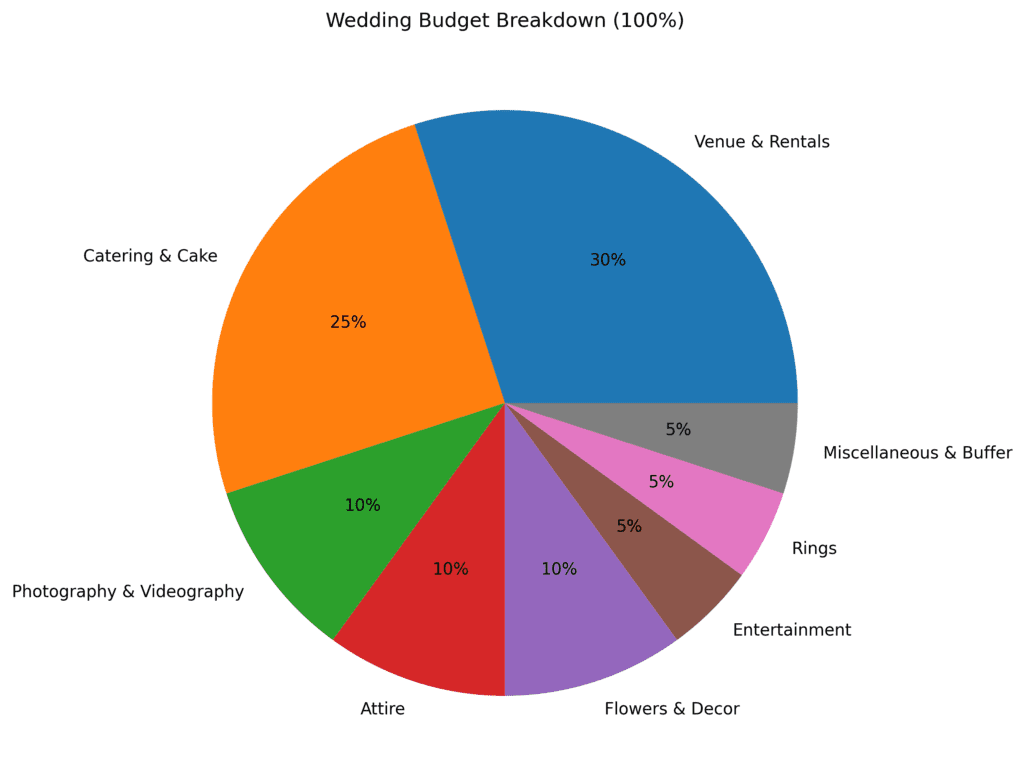
This shows that venue and catering alone account for over half of most wedding budgets, which is why guest count has the biggest impact on total cost
Step 3: Build Your Budget Around Guest Count (Not Decor)
As outlined in Step 1 above, your guest count is the single most powerful tool for controlling your overall budget
Every additional guest increases costs for:
- Food and drinks
- Tables, chairs, and rentals
- Invitations and stationery
- Favors and details
- Staffing and service fees
Here is a realistic cost scale:
- 50 guests: $15,000–$22,000
- 75 guests: $20,000–$30,000
- 100 guests: $25,000–$35,000
- 150 guests: $35,000–$50,000+
- 200+ guests: $50,000–$75,000+
Reducing your guest list by even 20–30 people can significantly reduce overall cost without changing the experience of your wedding day.
Suppose you are trying to keep your wedding under $10,000. Read this blog on planning a wedding under $10,000.
Step 4: Choose Your Wedding Priorities Before Spending
Every couple has different priorities. Some value food and guest experience, others value photography or entertainment.
Before booking anything, decide:
What are our top three priorities for the wedding?
Once you know this, your budget becomes intentional instead of reactive.
This step is what separates stress-free weddings from overspent weddings.
A useful exercise: before booking a single vendor, sit down together, and each write your top three wedding priorities on separate pieces of paper. Then compare. Most couples assume they know what their partner prioritizes and are surprised by the results. A bride who values photography above everything and a partner who most wants great food need to know that early, before conflicting budget allocations create tension.
Common priority misalignments I see after 35 years of planning: one partner prioritizes the photographer, the other prioritizes the band. One wants a floral ceremony arch, the other wants the bar to be open all evening. Neither priority is wrong. But they need to be surfaced before the budget is allocated.
For a complete guide to how hidden costs catch couples off guard, the hidden wedding costs guide on this site covers every expense most couples never see coming. Hidden Wedding Costs No One Tells You About.
If you want to DIY your wedding decor to save money, read this blog on DIY wedding decor.
Step 5: Location, Season, and Timing Matter More Than Most Couples Realize
Your wedding budget is heavily influenced by:
Location
Major cities and high-demand destinations cost significantly more due to vendor pricing, labor, and venue demand.
Season
Peak wedding season (spring and fall) is more expensive than winter or off-season months.
Day of the week
Weekends are premium pricing. Weekdays and Sundays often offer savings.
Small changes here can save thousands without changing your wedding vision.
Step 6: Common Wedding Budget Mistakes to Avoid
Even well-organized couples run into budget issues because of overlooked costs.
The most common mistakes include:
- Forgetting taxes and service fees
- Not budgeting for gratuities
- Underestimating bar and alcohol costs
- Ignoring dress alterations and accessories
- Not including a contingency fund
A strong wedding budget always includes a 5–10% buffer for unexpected costs.
Step 7: How to Stay on Budget During Planning
Creating a budget is only half the process. Sticking to it is where most couples struggle.
To stay on track:
- Track every deposit and payment in real time
- Use a spreadsheet or wedding budget tool
- Compare all vendor quotes before booking
- Avoid emotional or impulse purchases early in planning
Once you spend your first 20–30% of the budget, the remaining decisions become easier.
For a complete wedding planning timeline that keeps your budget decisions in the right order, the 12-month and 6-month wedding planning guides cover every milestone.
Step 8: Why Most Couples Go Over Budget (And How to Avoid It)
The biggest reason couples exceed their budget is not poor planning; it is scope creep.
Scope creep looks like:
- Just adding one more floral arrangement
- Upgrading the menu slightly.
- Adding extra guests late in planning.
- Small décor upgrades that add up
The solution is simple: every change must be checked against your total budget, not your category budget.

Now that you have your budget worked out, this guide will help you by providing a 12-month and a 6-month step-by-step wedding planning guide.
Helpful Wedding Budget Tools
For couples managing a gift registry alongside their budget, MyRegistry.com is the most convenient way to combine items from multiple stores into a single list. It also supports honeymoon fund contributions, which is particularly useful for couples whose guests ask about gifts outside the traditional registry format.
Frequently Asked Questions About Wedding Budget Planning
Most weddings in the U.S. cost between $25,000 and $40,000, depending on guest count, location, and vendor choices. Smaller weddings can be significantly less
Venue and catering are typically the largest expenses, often making up more than 50% of the total wedding budget combined.
A realistic budget for 100 guests in 2026 is typically between $25,000 and $35,000, depending on location and vendor selections. For more detail on reception planning within this budget, the Wedding Reception Planning Guide walks through every category in the order you will encounter it.
This blog will help you in planning your wedding reception.
Start by setting your total budget, then divide it into major categories like venue, catering, photography, attire, and décor using percentage guidelines.
Yes. It is recommended to include at least 5–10% of your total budget for unexpected expenses such as fees, tips, or last-minute changes.
Most wedding planners recommend allocating 10 to 12 percent of your total wedding budget to photography and videography combined. On a $30,000 budget, that is $3,000 to $3,600. Photography is one area where cutting corners is consistently regretted; the photos are what remain long after the wedding day, and the difference between a $1,500 photographer and a $3,000 photographer is usually significant.
A typical wedding budget breakdown allocates roughly 30 percent to venue and rentals, 25 percent to catering and bar service, 10 percent each to photography, attire, and flowers and decor, 5 percent to entertainment, 5 percent to rings, and 5 percent to a contingency buffer. On a $30,000 budget, that means approximately $9,000 for venue, $7,500 for catering, and $3,000 each for photography, attire, and decor.
Start with five columns: category, budgeted amount, actual amount, deposit paid, and balance due. List every wedding category in the rows. Enter your percentage-based budgeted amounts first, then update the actual column as you book vendors and receive invoices. Track deposits separately so you always know your outstanding balance. A simple Google Sheet or Excel spreadsheet works perfectly for this. Amazon also carries printed wedding budget planners if you prefer to track on paper.
The biggest savings come from reducing guest count, choosing off-peak dates, simplifying catering options, and selecting local vendors.
DIY Wedding Decor to Save Money
DIY Favor Ideas
Wedding Decor Under $500
Hidden Wedding Costs No One Tells You About
Follow me on Pinterest for more great wedding ideas.
Final Thoughts
A successful wedding budget is not the cheapest version of your wedding; it is the most intentional version.
When your budget reflects your priorities, guest count, and real-world costs, you eliminate stress and gain control over the entire planning process.
A well-built budget does not limit your wedding. It protects it.
For a complete planning timeline that works alongside your budget, the 12-month and 6-month wedding planning guides walk you through every decision in the right order.
Once your budget is set, the wedding registry guide will help you build a registry that supplements your budget by directing guests toward gifts you genuinely need.
Chris Ramsay is a wedding planner with over 35 years of experience in hospitality, country clubs, and event planning. She shares practical wedding advice, budget-friendly ideas, and real-world tips to help couples plan stress-free weddings at Well Chosen Weddings. Learn more about her on her about page.